 The Fall of Granada
A column by Abdelkader in *Trouw* about our visit to Sarajevo
The spiritual heart of Europe beats between Granada and Istanbul
by Abdelkader Benali
Published in *Trouw* on October 5, 2026
In the National Museum of Bosnia and Herzegovina, directly across from the hotel where I am staying, lies a fourteenth-century Jewish book that survived the fall of Granada in 1492: the Haggadah. It is a magnificent object to behold, telling the story of the Exodus from Egypt. After the Inquisition forced Jews to convert, tens of thousands of them packed their bags and headed for the Ottoman Empire, where the Sultan welcomed them with open arms.
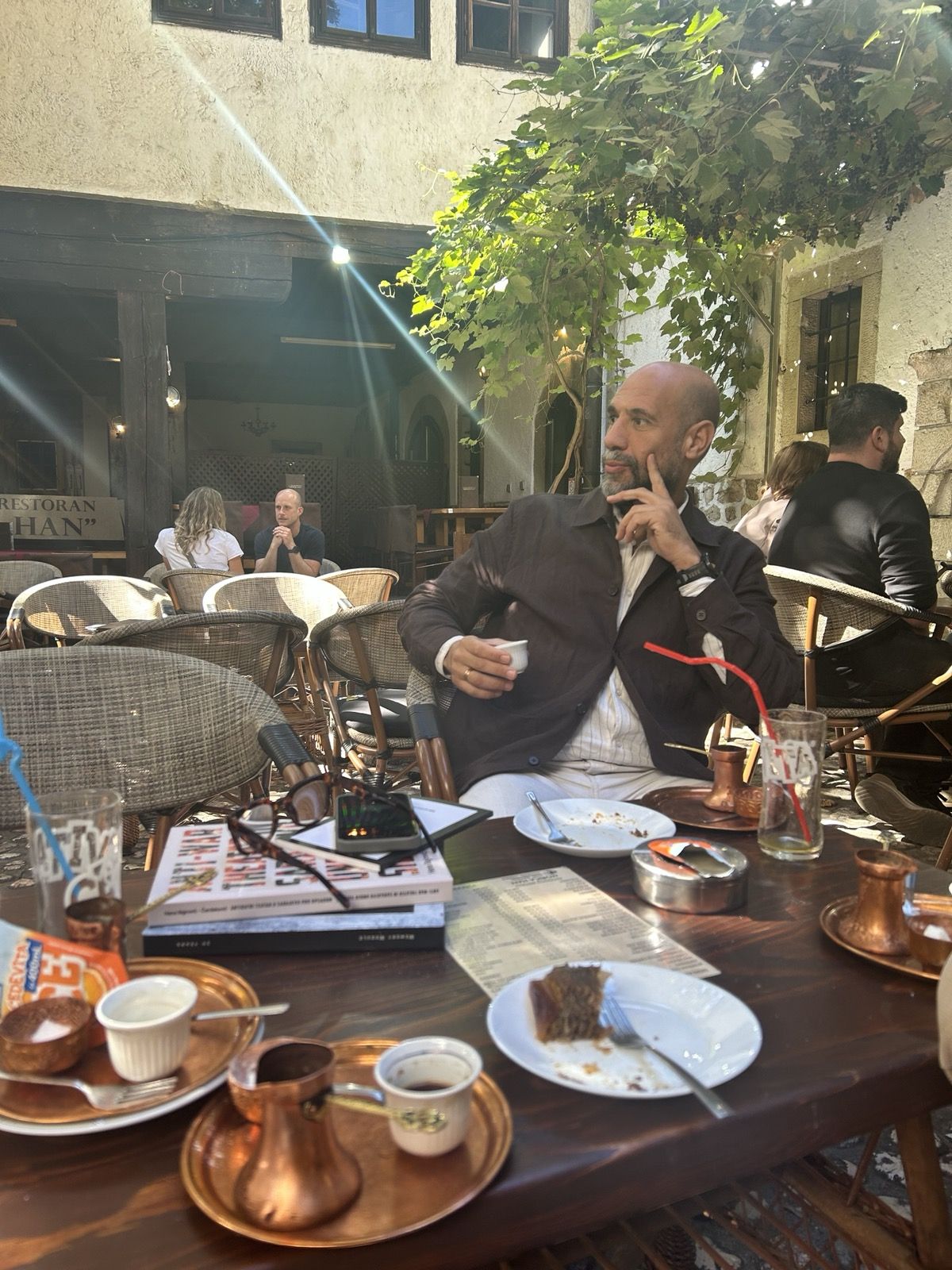
In Sarajevo, the Jewish community built a new home with that book—the one that had escaped destruction—as its beating heart. Unfortunately, I cannot view the book itself, as it is Sunday. Instead, I walk to the Old Town and settle into a *khan*—a warehouse where goods from as far away as India were once unloaded. Surrounded by Turkish tourists, we drink Turkish coffee and eat Turkish delight. The call to prayer rings out from the surrounding minarets; a man unrolls his prayer mat, while next door, someone fills a glass with beer. This is my Europe.
At the Sartr Theatre, I am performing *The Fall of Granada* with the group Hotel Modern—a show about the rise and fall of Moorish civilization. An acquaintance from Bosnia had seen the performance in the Netherlands and came up to me afterwards, visibly shaken: "Sarajevo could easily have become another Granada." That hit home. I delved into the history books. Sarajevo was under siege from April 5, 1992, to February 29, 1996; Our hotel—the former 1984 Olympic hotel—is located on "Sniper Alley," where snipers ruthlessly fired at anything that moved. Sarajevo came under fire but did not break. And theater played a vital role in that resistance.
I read in the book *Anti-war Theater in Sarajevo Under Siege* that, during the siege, theater became as essential as water and food; the theater became a factory for resilience. Susan Sontag came from New York to direct Samuel Beckett’s *Waiting for Godot* here. In wartime, waiting becomes a form of resistance—as long as there is theater, there is life. Amidst the surrounding pessimism, people fought back through theatrical gestures, satire, tragedy, and comedy.
Every step carries history
We are performing our show at the War Theater—where the artistic resistance began—not far from the Old Town; around the corner lies a cemetery with Islamic graves, the gate bearing the Seal of Solomon. Every step carries history. During the Second World War, the Sarajevo Haggadah was smuggled out and taken to safety by an Islamic cleric who hid it in the mosque. During the siege of Sarajevo, the manuscript was moved to the central bank and tucked away in a vault.
After the capture of Granada, the Inquisition consigned thousands of Jewish and Moorish books to the pyre; a thousand years of culture went up in flames. The Haggadah escaped this destructive frenzy. For the people here, Granada is a mirror city—it could have been their fate, yet it wasn't; it was a fallen city. They held out for 1,425 days. The book breathed freely once more. Mosques are being renovated by the Turkish government all over the place; a Bosnian man tells me that Erdoğan came to inaugurate a restored mosque. He describes how the Turks are refurbishing everything related to Ottoman heritage. Sarajevo—the spiritual heart of Europe—beats between Granada and Istanbul.
